
Webb County Historical Records Collections
The confirmed Laredo directory trail is split among state listings, a staff-mediated local collection, and a heritage archive. The Texas State Library and Archives Commission, or TSLAC, names specific Laredo years rather than a complete uninterrupted run. The Luciano Guajardo Historical Collection at the Joe A. Guerra Laredo Public Library holds city and telephone directories alongside maps, microfilm, newspapers, yearbooks, family trees, clippings, photographs, oral interviews, and manuscripts. Its policy does not publish a full directory shelf list, so an edition and call number still need staff confirmation.
| Collection | Years | Where held | Access |
|---|---|---|---|
| Laredo city directories listed by TSLAC | 1920–21, 1923–24, 1930, 1935, 1964, 1968, 1970, 1972–73, 1976, 1981, 1985 | TSLAC list and LPL leads | Confirm edition, shelf location, and copy rules. |
| Luciano Guajardo Historical Collection | Directory years not fully published | Joe A. Guerra Laredo Public Library | Reference-only, staff retrieved and handled. |
| WCHF “1930 City Directory (II)” | 1930 | WCHF research-file store and archive | Displayed digital fee: $48; check reproduction terms. |
| Sanborn map holdings | 1885, 1889, 1894, 1900, 1905, 1909, 1916, 1925 | Library of Congress | Digital sheets for block context, not title or occupancy proof. |
TSLAC’s Laredo directory list is the clearest year-by-year starting point. It does not identify every publisher, edition frequency, street-index status, or digitization location. Treat an unlisted year as a gap to investigate, not proof that no volume was printed or kept.
The state directory list is shown in the image below, which makes the irregular sequence easier to preserve in a research log.
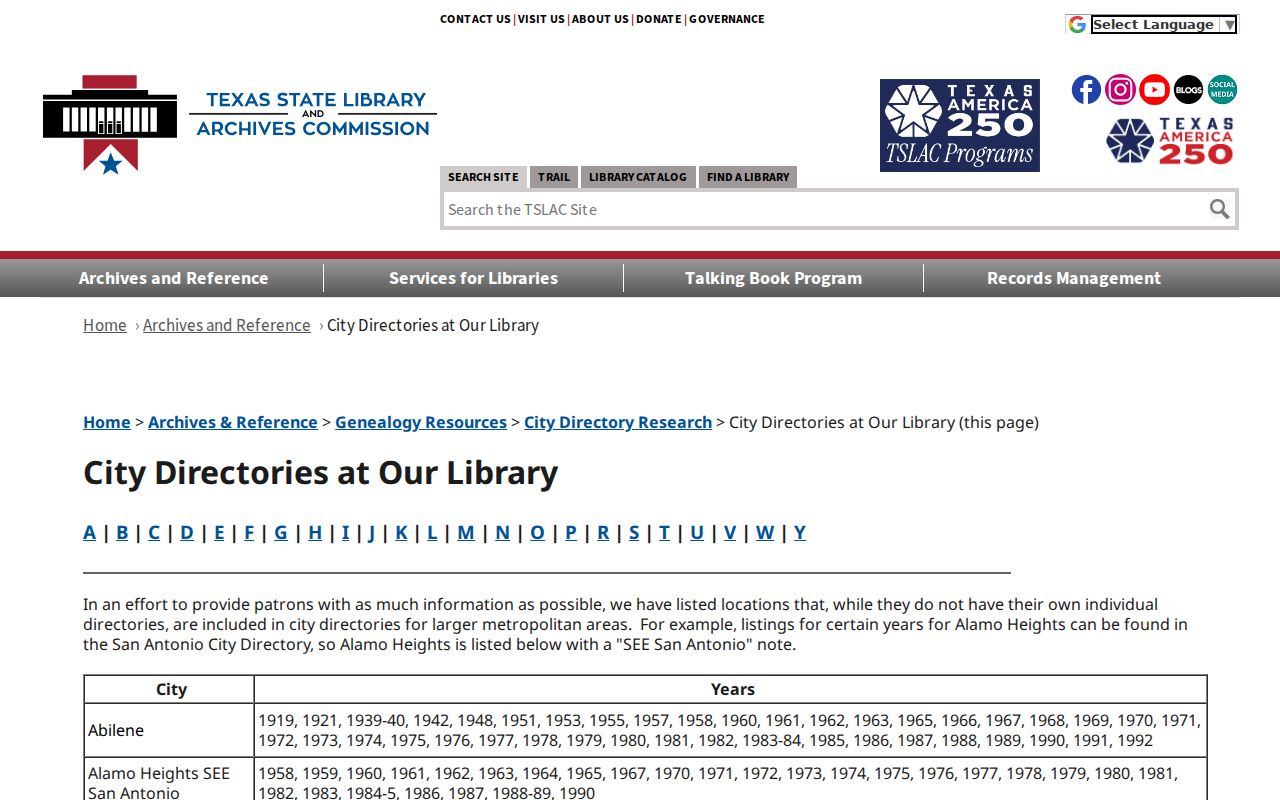
Record the edition year exactly as listed, then add the library call number, page, and section after the volume is inspected.
Laredo Records Reference Access
The Luciano Guajardo collection is not an open shelf. Visitors sign a log, and staff retrieve and handle the material. The collection is reference-only. Photocopies are considered case by case under current copy fees, while cameras and phones require permission or an appointment. The policy also leaves copyright and libel responsibility with the researcher. Those limits matter when a useful name or address appears on a fragile page.
There are several documented ways to ask for help: visit in person, call, send a letter, email, or use Ask-a-Librarian. A precise request is more workable than a broad surname search. State the Laredo directory year or edition, whether the need is a name or street section, the street and number if known, surname variants, and any desired newspaper, yearbook, map, oral-history, or family-tree lead. Ask for the call number, page, and reproduction rules with the response.
Webb County Heritage Records Files
The Webb County Heritage Foundation, or WCHF, adds a separate local-history route. Its archives describe documents, photographs, maps, manuscripts, oral histories, and local literature. The online research-file store lists about 190 local files, including surname and history topics as well as “1930 City Directory (II).” The displayed price for that directory file was $48.00 during the research review. On-site and digital terms can differ by page count and intended use.
WCHF reported that research services were unavailable while its archives were relocating or reorganizing. That status makes an online listing a lead, not a promise of immediate staff work. Contact the foundation before travel, identify the file by its printed title, and confirm whether the listing represents a scan, a research file, or material available only at the archive.
WCHF’s research-file catalog shows the local files route referenced above.
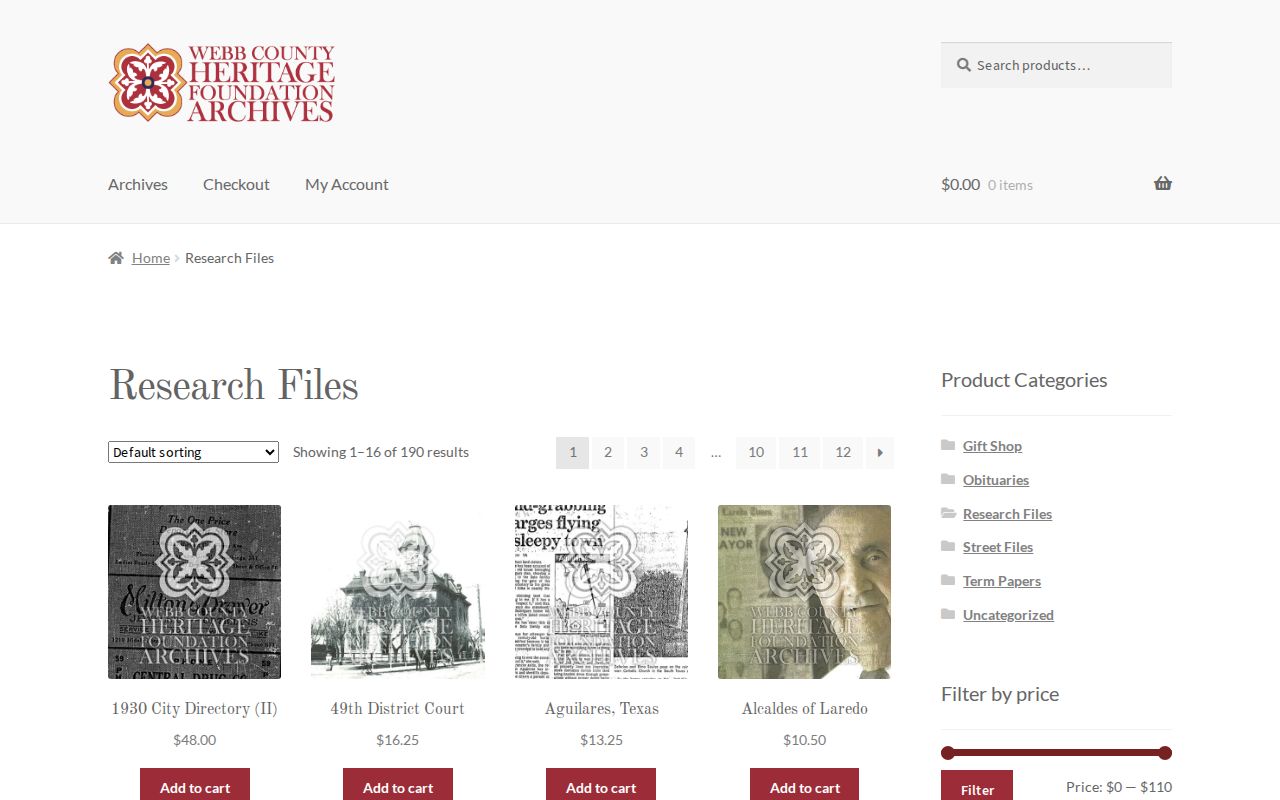
The catalog supports a targeted request, but it does not replace checking the original edition, page, and archive access terms.
Reading a Webb County Directory Entry
No local directory page image was available for a literal Laredo entry inspection, so the fields below are a checklist rather than a claim about every edition. Directories may arrange people alphabetically, by street or telephone, or with professional and civic information. Read the title page and abbreviation key before treating any mark as a fact. A surname, address, or occupation alone is often not enough to separate two people with similar names.
| Name as printed | Preserve initials, surname order, spelling, and any variant before normalizing it in notes. |
|---|---|
| Household clue | Record a spouse reference or widow notation only if the inspected edition actually prints one. |
| Work or business clue | Note occupation, employer, professional listing, or business address when it appears. |
| Street address | Copy the house number, street, and city label as printed, then compare it with maps and deeds. |
| Edition evidence | Keep the year, page, section, and nearby address entry so another researcher can recheck the result. |
- Criss-cross directory
- An address-ordered directory section, if a volume contains one. It can connect a street number to a dated listing.
- Householder index
- A name-oriented index for the person recorded as the household contact or listing subject, not a complete household roster.
- Abbreviation key
- The publisher’s explanation of shortened words and symbols. Photograph or transcribe it before interpreting an entry.
Laredo Directory Name Variants
Laredo research needs a careful spelling audit. Spanish compound surnames and inconsistent indexing can place one family under more than one ordering, an initial, or a shortened form. Search both surname orderings and relevant initials. Preserve the original spelling in the citation, then use date, place, address, and relationship evidence to decide whether two results belong together. A close match is a lead, not an identity conclusion.
This care also applies to a disappearing listing. A person may have moved, used a variant, become unlisted, or been missed by an irregular edition. The right response is to inspect the next available directory, a newspaper notice, a map, a deed or tax event, and a released census record rather than declaring a household gone from one blank year.
Laredo Street Records on Sanborn Maps
Old directory addresses gain context from Laredo’s Sanborn sheets. The Library of Congress holds linked items for 1885 and 1889, then 1894 with nine sheets, 1900 with ten, 1916 with 18, and 1925 with 28. The maps can show a block’s orientation, building footprint, material or use, adjacent structures, and nearby civic or rail landmarks. They do not establish ownership or prove who was present at an address.
Laredo’s streetcar history offers a useful date marker for downtown block research. Texas Historical Commission material places the debut on December 5, 1889, a bridge extension four months later, four lines across 6.21 miles with nine cars, and an end in 1935. Pair a directory address with the appropriate Sanborn sheet and map date, but do not infer that a listed person used the line.
Webb County Records Collection Timeline
The available record trail has several useful markers, but not a complete publishing history. Laredo Public Library began in 1916 and is now a local-history partner with materials that include directories and maps. TSLAC’s list first identifies the Laredo runs for 1920–21 and 1923–24, then names 1930 and 1935. The next confirmed entries are 1964, 1968, 1970, 1972–73, 1976, 1981, and 1985. The source does not identify a definitive first printed directory, a final printed directory, or every publisher.
- Before 1920: use deeds, tax rolls, maps, newspapers, and archive collections because no earlier Laredo directory year is confirmed by the state list.
- 1920–35: compare the listed editions with released census records, deeds, tax rolls, and Sanborn map dates.
- 1964–85: retain the exact listed year, then check later editions, local newspapers, and staff-held collections for an address change.
Do not turn the gaps into a continuous sequence. The correct citation distinguishes a directory year located from a year not located in the reviewed catalog text.
Trace Webb County Directory Volumes
Trace a household in intervals, not as though the volumes were annual and complete. Start with one confirmed listing, then compare the closest earlier and later available editions. Pair the result with a released census schedule, a deed or tax event, and a dated newspaper notice. Federal detailed population schedules follow the 72-year release rule, and an entry in the same year as a census record still needs an address, relationship, or other check before the two are joined.
- Copy the printed name, address, edition, page, and section from the first located listing.
- Check the next available Laredo year in either direction, noting each spelling, address, or status change.
- Compare the address with the appropriate Sanborn sheet, plat, deed legal description, or tax-roll clue.
- Use a released census schedule to test household relationships and timing, not to assume identity from a surname alone.
- Check dated newspapers, probate material, or archive requests when a move, death, or family relationship needs support.
TSLAC’s Webb guide reaches further back than the listed volumes. It identifies deeds beginning in 1848, tax rolls from 1851, marriages from 1852, probate minutes from 1851, and additional court and naturalization volumes. Those sources help bridge an older gap, but each has its own reel, volume, access, and copy rules.
Newspapers Beside Webb Records
Directory research benefits from issue-level newspaper checking. A November 2024 Portal to Texas History announcement described National Digital Newspaper Program additions for late-nineteenth-century Laredo Daily News, early-twentieth-century Laredo Weekly Times, and 1935 Laredo Times material, with more expected. Search an exact name or street, then save the issue date and page. An OCR hit must be checked against the page image and corroborated with an archival or official record.
The strongest result is a short evidence trail: edition and page for the directory, issue and page for the newspaper, and a separate record for the address or relationship. The published directory list does not identify a definitive first or final Laredo directory, nor does it supply every publisher. Keep those limits in the note instead of filling them with assumptions.