
Webb County Previous Residents Sources
An address history starts by separating transfer records from household records. The Webb County Tax Assessor-Collector can supply an account, owner label, situs and mailing addresses, tax year, and related identifiers. The Clerk index can then connect parties and a legal description to recorded instruments. For older work, TSLAC volumes and microfilm, city directories, Sanborn maps, released federal census schedules, and archive requests each cover a different period. A tax or deed name is not the same as a complete record of who lived at the property.
| Source | Years it covers | Where held | What it shows |
|---|---|---|---|
| County Clerk and TexasFile deed index | Portal displays full index from 1867; current-through metadata changes | TexasFile and Webb County Clerk | Grantor, grantee, instrument, date, type, legal description, and image lead. |
| Webb deed books and microfilm | 1848–1887 in the TSLAC guide | TSLAC, depositories, or possible FamilySearch affiliate | Original or transcribed deed books and indexes before the portal cutoff. |
| Webb tax rolls | 1851–1910 | TSLAC reels 124001–124002 | Taxable property and name clues by year, not title. |
| Laredo directories | 1920–21, 1923–24, 1930, 1935, 1964, 1968, 1970, 1972–73, 1976, 1981, 1985 | TSLAC, LPL, and WCHF leads | Dated name, address, or business snapshot; exact run remains a gap. |
| Sanborn maps and released census schedules | Sanborn: 1885–1925 linked; census follows the 72-year rule | Library of Congress and federal repositories | Block context and household evidence, not title proof. |
Begin with the most recent record that contains both a usable legal description and an address. For an early period, begin instead with the TSLAC guide, a reel or volume citation, and a clearly stated date range. Local permit coverage does not have a verified online starting date; an existing permit request goes through Laredo Building and Development or the appropriate public-records route.
Webb County Deed Years and Gaps
The online index is a useful first pass, but its displayed full-index coverage begins in 1867. TSLAC documents Webb deed records beginning in 1848 and deed books or indexes through 1887. That makes 1848 through 1866 a change in access route, not a missing-history conclusion. Use the guide’s reel and volume references, county volumes, microfilm, or a researcher request when the chain reaches the portal boundary or a difficult handwriting or spelling problem.
TSLAC also lists marriage records beginning in 1852, probate minutes beginning in 1851, tax rolls beginning in 1851, and court or naturalization volumes. Those are separate record groups. They can support a family-history or estate clue, but they must not be silently merged into a deed sequence. The research review found no verified courthouse fire, flood, or particular destruction event, so a blank result should be labeled as a gap rather than attributed to a loss story.
TexasFile’s Webb County deed index shows the name, instrument, and legal-description route used for the newer part of a chain.
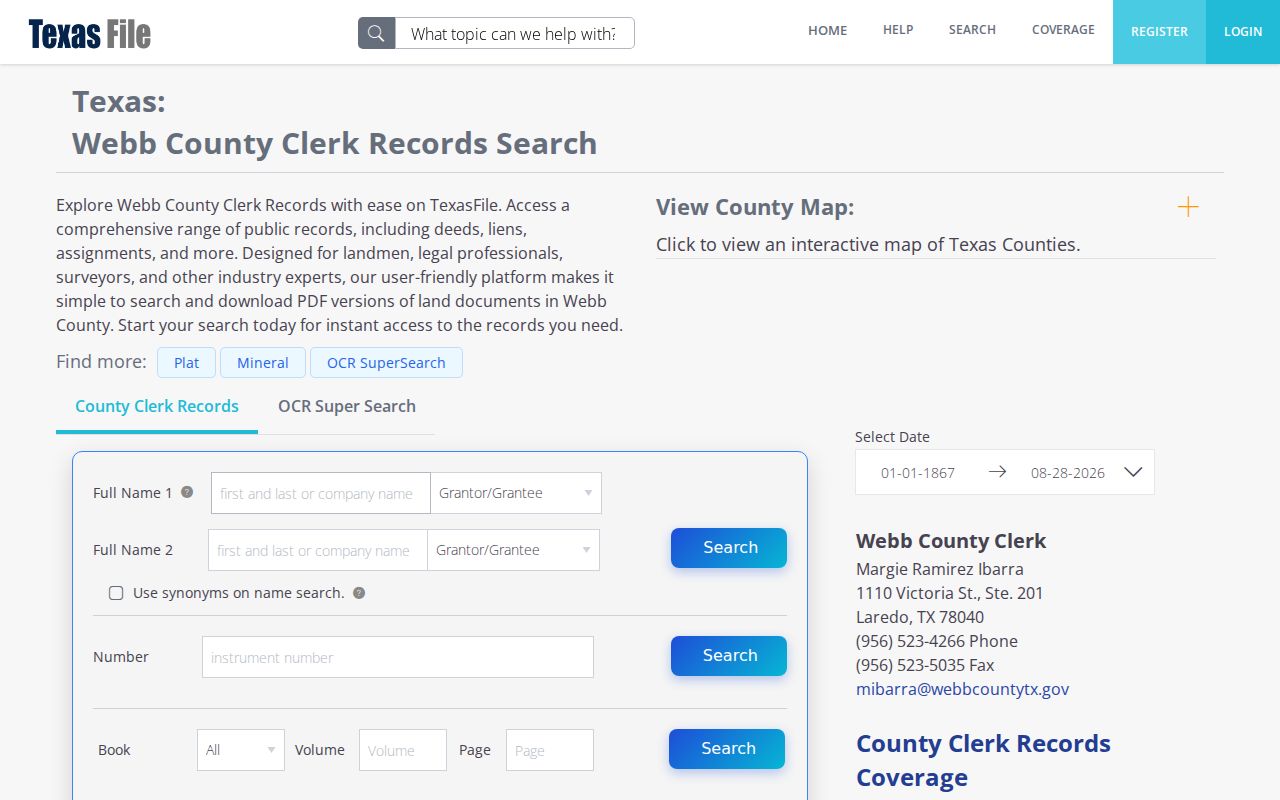
Use an index result to locate the instrument, then read the image or request the record before drawing a conclusion about the property sequence.
Trace a Webb County Deed Chain
For a deed chain, first keep the situs address separate from the mailing address. The situs is the taxable property location, while the mailing address is where tax notices are sent. It can belong to another property, an agent, a business, or a former address. Capture the tax account or billing number, legal description, subdivision, lot and block when present, CAD reference or property ID, and tax year. Those fields are stronger bridges than a street number by itself.
- Use the tax or CAD route to identify the address-linked legal description and the party named on the current record.
- Search that party as grantee in the Clerk or TexasFile index to locate the likely purchase instrument.
- Read the instrument for the seller, buyer, recording date, prior-instrument reference, legal description, consideration language, and any release or restriction.
- Search that seller as grantee to find the earlier acquisition, while checking that the legal description still matches the same property.
- Repeat until the online index ends or the legal description changes, then move to the TSLAC or county volume route.
The index accepts first name, last name, or business name, plus instrument number, volume, page, and legal-description fields such as subdivision, lot, block, tract, survey name, and abstract. Observed result columns include County, Date, Type, Grantor, Grantee, BVP/No., and Legal Desc. Image preview or download can be paid. A grantor or grantee hit is an index lead, not a title opinion.
Webb County Previous Residents Terms
Old records use labels that need plain definitions. Keeping the terms distinct helps avoid treating a transfer, a tax account, and a directory listing as though they report the same thing.
- Grantor and grantee
- The grantor is the party transferring an interest in an instrument. The grantee is the party receiving it.
- Chain of title
- A sequence of recorded transfers and related instruments traced backward through the same legal description, not a guarantee that every interest has been resolved.
- Legal description
- The lot, block, subdivision, survey, abstract, tract, or other recorded property description. It often remains more reliable than a changing street address.
- Situs address
- The taxable property location. It differs from a mailing address, which is only where notices are sent.
Webb County Past Residents in Directories
City directories add a dated household layer after the deed trail is established. They can hold an alphabetic name section, a street or address section, telephone material, or professional and civic listings, depending on the edition. The locally confirmed Laredo years are irregular, so a directory is a snapshot rather than an annual roster. Use the printed name, address, page, edition, and abbreviation key as the record citation. The collections and their access rules are described on the Webb County City Directory page.
LPL’s Luciano Guajardo Historical Collection is reference-only, staff handled, and reachable in person, by phone, letter, email, or Ask-a-Librarian. Ask for the exact directory year, edition, street or name section, page, and whether the item is address-reverse, telephone, business, or a general directory. WCHF offers research files, including a 1930 directory file, but reported its research service unavailable while archives were relocating or reorganizing. Contact before travel.
TSLAC’s directory-year list provides the dated collection sequence used when pairing a household clue with other records.
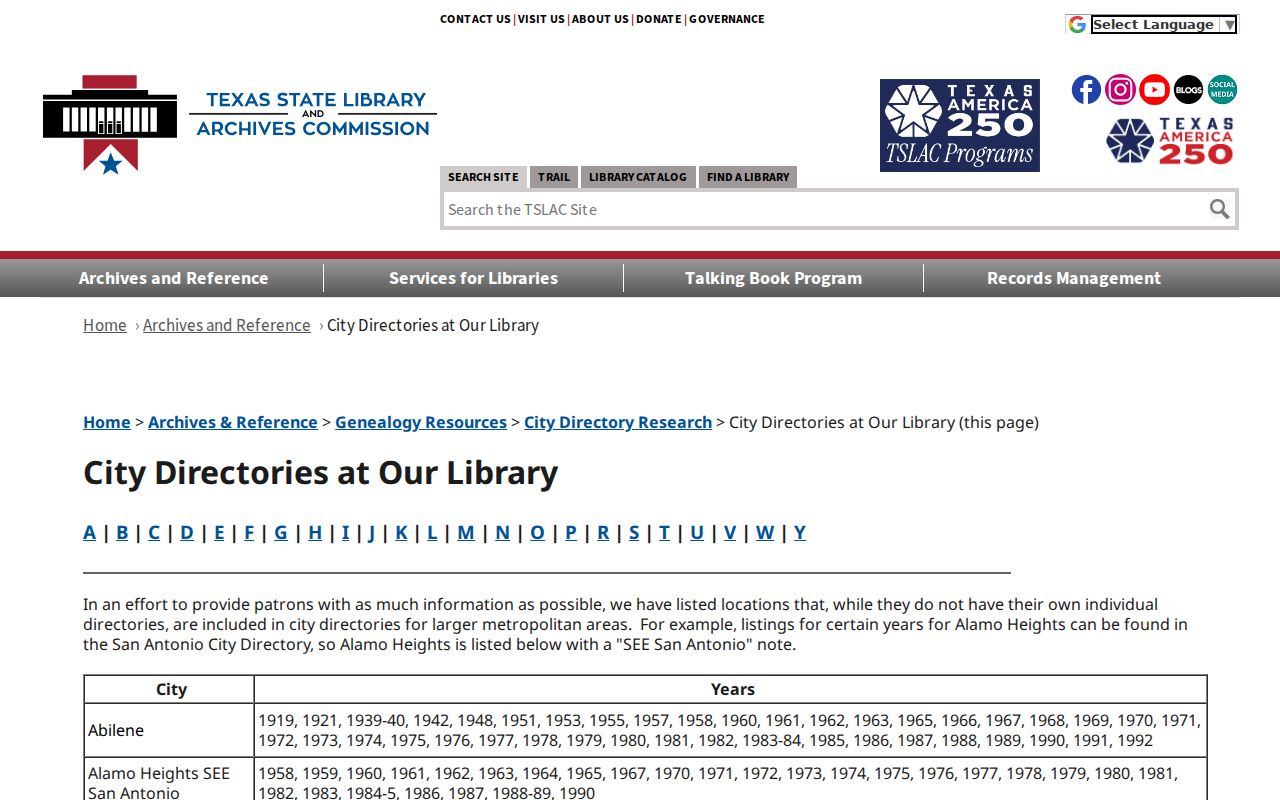
Use a listed year to plan an inspection, then verify the edition, publisher, page, and available address section with the holding institution.
Webb County Census Pairing
Pair a directory entry with a released federal census record by date and address, not just a matching surname. Detailed decennial schedules are released under the federal 72-year rule. Compare the household’s relationship, age, place, ward or address where present, and the directory’s printed form of the name. A 1930 directory listing and a 1930 census entry can still identify different people unless the address or relationship evidence supports the connection.
A practical sequence is: directory name and address, appropriate Sanborn sheet or map, plat or legal description, deed or tax-roll event, then a later directory, newspaper, probate record, or released census schedule. Mark each entry as listed, recorded, filed, or reported. That vocabulary preserves uncertainty and prevents a past household clue from becoming a claim about continuous residence.
Laredo Blocks on Sanborn Sheets
Sanborn maps are the best local block-context layer for an old address. The Library of Congress has Laredo sheets for 1894, 1900, 1916, and 1925, plus linked 1885, 1889, 1905, and 1909 items. They can show block orientation, building footprints, construction material or use, adjacent businesses, and nearby landmarks. They do not establish title, current address, or an occupant list.
Laredo’s 1889 streetcar opening, bridge extension four months later, four lines over 6.21 miles, nine cars, and 1935 end date can anchor historical map research around a block. It is context only. A map and directory cannot establish that a particular listed person rode a streetcar or used a specific route.
Webb County Previous Residents Limits
Property history has limits. A tax mailing address, homestead indication, deed-index result, map, or directory entry does not prove current occupancy. No verified public Laredo utility-customer lookup was located, and utility subscriber identity should be treated as private. Street names, house numbers, annexation, and postal-city labels can also change. No official street-renumbering year was verified, so compare Sanborn, directory, plat, and map evidence before equating old and modern addresses.
Webb County Archive Request Routes
When a portal is not enough, preserve the exact party spelling and aliases, approximate date, instrument type, volume or page or instrument number, subdivision or lot and block or survey and abstract, situs address, and whether an uncertified index result or a certified copy is needed. The County Clerk’s public-property page directs researchers to its live workflow, while unusual or historical instruments may need direct office confirmation. Current fees change, and the county’s web fee page and a 2025 fee PDF differed on selected amounts.
For pre-digital material, TSLAC’s Webb guide identifies deeds, marriages, probate, tax rolls, court material, and naturalization volumes with reel ranges. The library can route staff-mediated historical requests, and WCHF can be contacted about archive access after its reorganization. Keep a log with the source, volume or reel, page, search terms, date checked, and a note about what was not located. A well-marked gap is more useful than an unsupported connection.